Journal
Selfie vs real life: how your phone changes your jaw and chin
A selfie can shrink your chin and blur your jaw. Learn what the lens and the angle do, and how to take a photo that shows your real profile.
 Emily Westbrook
A selfie is not a record of your face. It is a record of your face seen from 30 centimetres away, from a slightly odd angle, through a wide lens. That combination changes your jaw and chin in ways the mirror and other people never show you.
If a selfie made you worry about a weak chin or a soft jaw, check the photo before you check your face. Most of what you saw may be geometry.
Three things matter: how far the phone is, how high it is, and whether you are in a true side view. Take them one at a time.
1. Fix the distance
Front cameras use a wide angle lens. Close to your face, a wide angle lens enlarges whatever is nearest to it and shrinks whatever is further back.
Your nose, forehead and brow are nearest. Your jaw, ears and the back of your head are further away. So the middle of the face grows and the edges recede. The jaw looks narrower and the chin looks like it has pulled back.
Move the phone back and the effect drops. A photo taken from about two metres, then cropped, looks closer to how a person sees you across a table.
Try it on yourself:
- Take a selfie at arm’s length.
- Put the phone on a shelf at eye level, two metres away.
- Use the timer and take a photo with the same expression.
- Compare the two at the same size.
If your jaw looks stronger in the distant photo, the lens was shrinking it.
2. Fix the height
Height changes the story as much as distance.
A phone held above your eyes is the classic selfie. It points down at you. Your forehead gets bigger, your chin shortens and the jaw line shrinks toward your neck. It also hides the fold under the chin, which is why many people like the look.
A phone held below the eyes looks up at you. The underside of the chin and the neck show. The nostrils show. The jaw can look heavy or double.
Level is fairest. The camera should sit at eye height and point straight at you. Keep your chin neutral. Do not tuck it in and do not lift it.
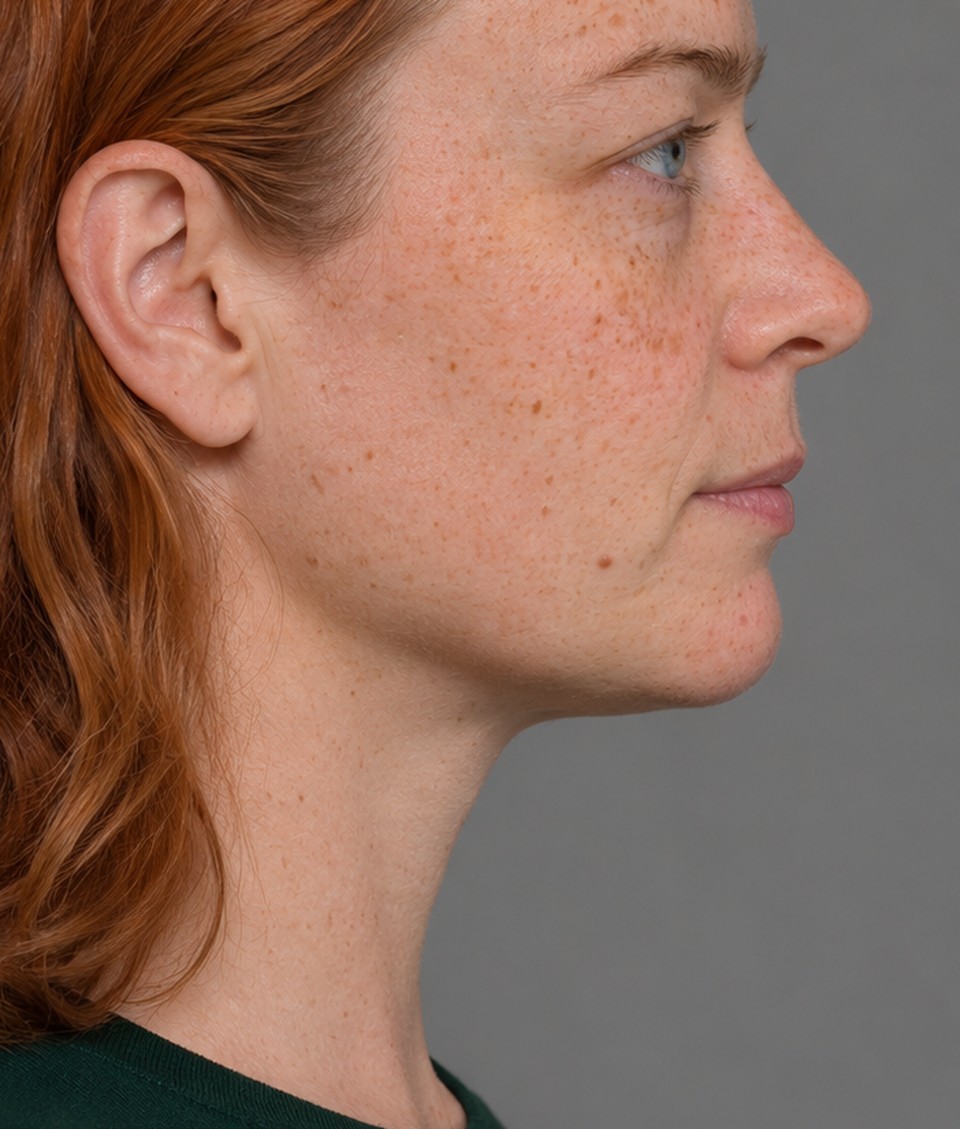
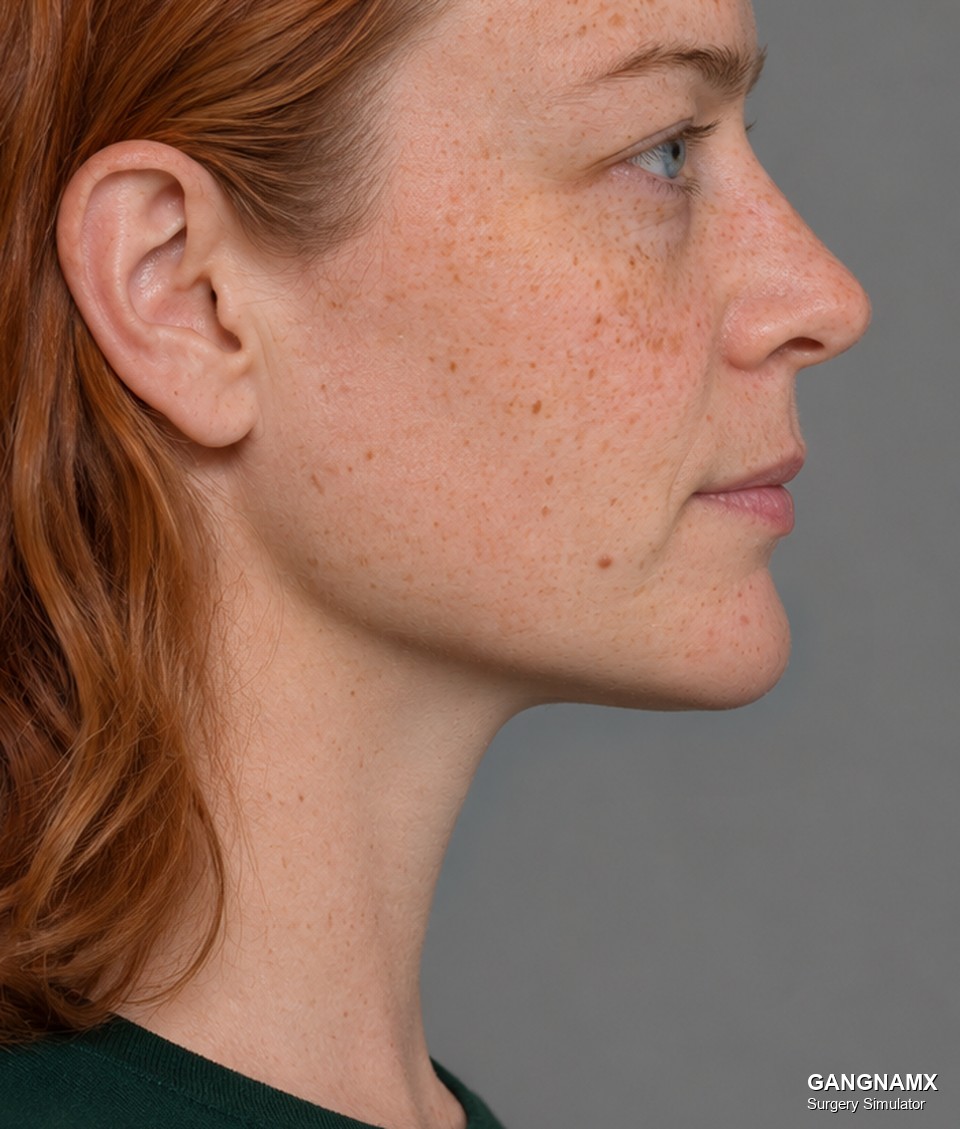
Our model is a helpful example. She has a round face, hooded lids and a soft, rounded jaw. From above, that jaw can look like it disappears into the neck. From eye level, with the camera back, the same jaw reads as a quiet, soft line. She did not change. The camera did.
3. Take a real side profile
If you want to judge your chin, you need a side view, and a true one. A selfie turned sideways is rarely a true profile.
A true 90 degree profile has three signs. You see one ear. You do not see the far eyelashes past the bridge of the nose. The camera is level with your eye.
Set it up so it is repeatable:
- Stand with your shoulder to a plain wall.
- Look at a point on the opposite wall at eye height, with your teeth lightly together.
- Ask a friend to hold the phone at eye height about two metres away, or lean it on a shelf and use a timer.
- Take three photos and keep the most level one.
Now you can look at the chin in a fair way. A good profile shows where the chin sits compared with the lips and the nose. That relationship is what a surgeon will ask about.
Here is our model’s side view. The chin sits slightly behind the line of the lips, and the jaw line is soft. In the simulation the chin comes forward and the jaw line is a little more defined, while the nose, lips and neck stay as they are.
4. Know the scale of a real change
Here is the part that surprises people. A real change to a chin is small. A few millimetres is a real, visible change in profile. A camera angle can change how the chin looks by far more than that.
That is why a selfie is a bad tool for deciding. The noise in the photo can be larger than the change you are considering.
Compare the real change with the camera effect. In the simulation above, the chin moves forward by a few millimetres. Projection is mostly a side view story, so a front photo would hide most of it.
Place the pair next to a selfie of yourself. If the selfie moves the chin more than the simulation does, you have your answer about what the camera is doing.
Chin projection should also be judged with your bite and your neck in mind. A surgeon looks at the teeth, the jaw joint and the neck line. Those are a clinical assessment and sit with the clinician, not with a photo.
Prepare for the room
A coordinator will ask for photos before your appointment. Photos taken the way a clinic needs them are different from the ones you post.
Bring three: front, true 90 degree side, and three quarter view. Take them in the same light, with your hair back and your face relaxed. Skip filters. Skip portrait mode. Skip the front camera if you can.
Write down your question in one line: “My chin looks small in side photos and I want to know if it is real.” Ask the surgeon to show you on your own profile what they would measure.
Do not bring only your selfie library. It is the least reliable evidence you own.
Before you decide
- Do: take a front photo and a true 90 degree side photo, level, from two metres away.
- Do: compare them with your best selfie at the same size.
- Do: note whether the chin or the jaw bothers you, not “my face”.
- Don’t: use portrait mode, filters or a phone held above your eyes as evidence.
- Don’t: decide from one photo on one day.
- Ask: what is bone, what is soft tissue, and what is angle on my own profile?
Simulation images by GangnamX.
 Plastic Surgery SimulatorKnow before you go.Simulate my face