Journal
Why does my nose look different every day? Check these four things first
Light, swelling, sleep and the side you photograph can all change how your nose looks. Here is how to separate a real shape from a daily wobble.
 Emily Westbrook
A nose that looks different every day is almost always a normal nose seen in different conditions. The bone and cartilage underneath stay put. What moves is light, fluid, posture and the distance between you and the lens.
That matters before any consultation. If you book based on one bad mirror morning, you are planning around a mood, not a shape.
Four things do most of the work. Check them in this order, because each one is free and each one can change your mind.
1. Fix the light first
Light decides where shadows fall, and shadows are what your eye reads as shape.
A bathroom light directly above the mirror throws a shadow under the tip. That shadow makes the tip look heavier and the nostrils look wider. A window to one side makes one side of the bridge look wider than the other.
Soft, even light from the front is the fairest. A window in front of you, on a cloudy day, does the job.
Try this for one week:
- Pick one spot facing a window.
- Take the same photo each day at the same hour.
- Keep your chin level and your face relaxed.
- Compare the photos side by side, not one at a time.
If the nose looks the same in seven photos taken in the same light, the daily change was the light.
2. Track the swelling
Soft tissue holds fluid. Salt, alcohol, a short night, a hot shower, hay fever and your cycle can all puff the skin over the nose and cheeks. The tip is skin and cartilage with very little room, so a small amount of fluid shows.
Puffiness has a pattern. It is usually worst in the morning and eases through the day. It often shows around the eyes and cheeks too, not only the nose.
Our model is a good example of why a single photo misleads. Her nose is wide across the nostrils, with round nostrils and a soft tip. In flat, bright light it looks broad and calm. In low light from the side it can read as bigger. Same nose, two verdicts.
Use the morning and the evening as a pair. Take one photo of each on the same day. A real shape does not change between breakfast and dinner. Fluid does.
Sleep position adds to it. Sleeping on one side can leave a slight pressure mark or a lopsided puff on that side. If the same side looks different every morning, note it, then look again at lunchtime.
A sudden change that does not settle, or a nose that becomes painful, blocked or one sided after an injury, is not a photo problem. See a doctor.
3. Control the angle you photograph
Your nose sits at the front of your face, closest to the lens. That makes it the feature a camera exaggerates most.
Hold a phone at arm’s length and the lens is about 30 to 40 centimetres away. At that distance, the nose can look larger relative to the ears and cheeks. Move the camera back and the same nose looks smaller.
Tilt matters too. A phone held low points up at the nostrils and shortens the nose. A phone held high shows the tip and shortens the bridge. Turn your head a few degrees and one nostril disappears.
Your mirror has its own habit. You are used to the flipped version of your face. A photo shows the true version, which can feel wrong even when nothing is wrong.
So when you want an honest look, use two views and keep them level:
- Front view: camera at eye level, arm out or on a stack of books, chin neutral.
- Side view: a true 90 degree profile. You should not see the far eyelashes past the bridge of the nose.
Ask someone to take it, or lean the phone on a shelf and use a timer. Do not use a selfie for the side view. Almost nobody can hold a true profile one handed.
4. See what a small change would look like
Once the light, the swelling and the angle are under control, a different question appears: do you want a change at all?
This is where a side by side helps more than a description. Words like “refined” or “a little smaller” mean something different to everyone. A picture removes the guesswork.
Here is our model’s side view. Her nose is moderate in projection with a rounded tip. In the simulation, the tip is refined and lifted, and the line from the bridge to the tip is smoother. Her nostrils and nose length stay as they are.
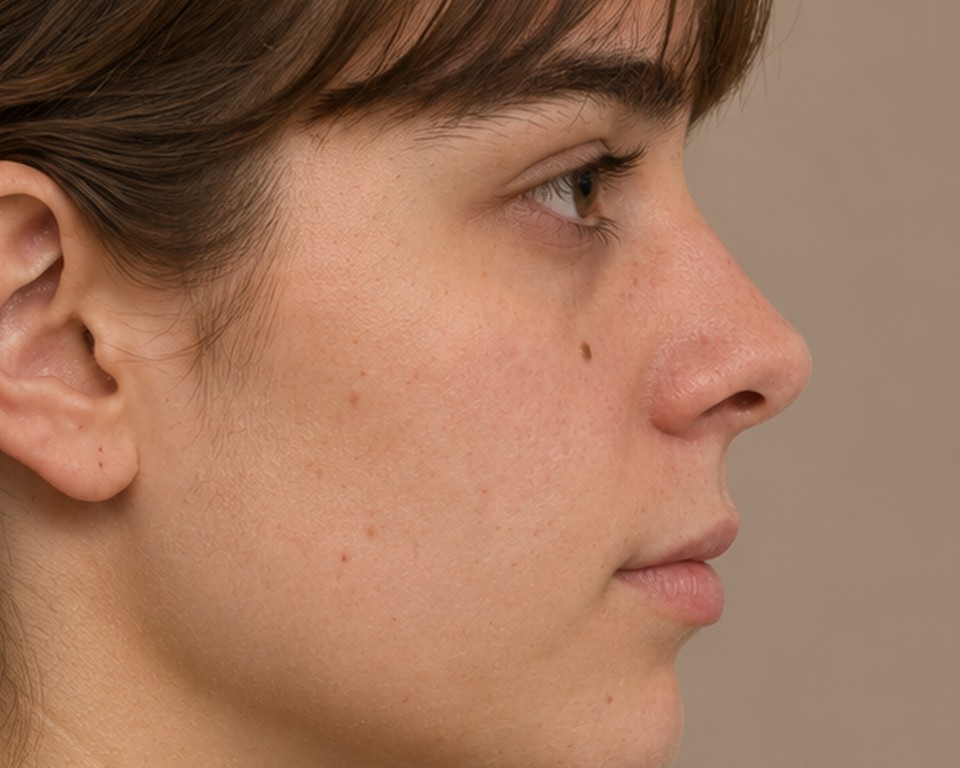
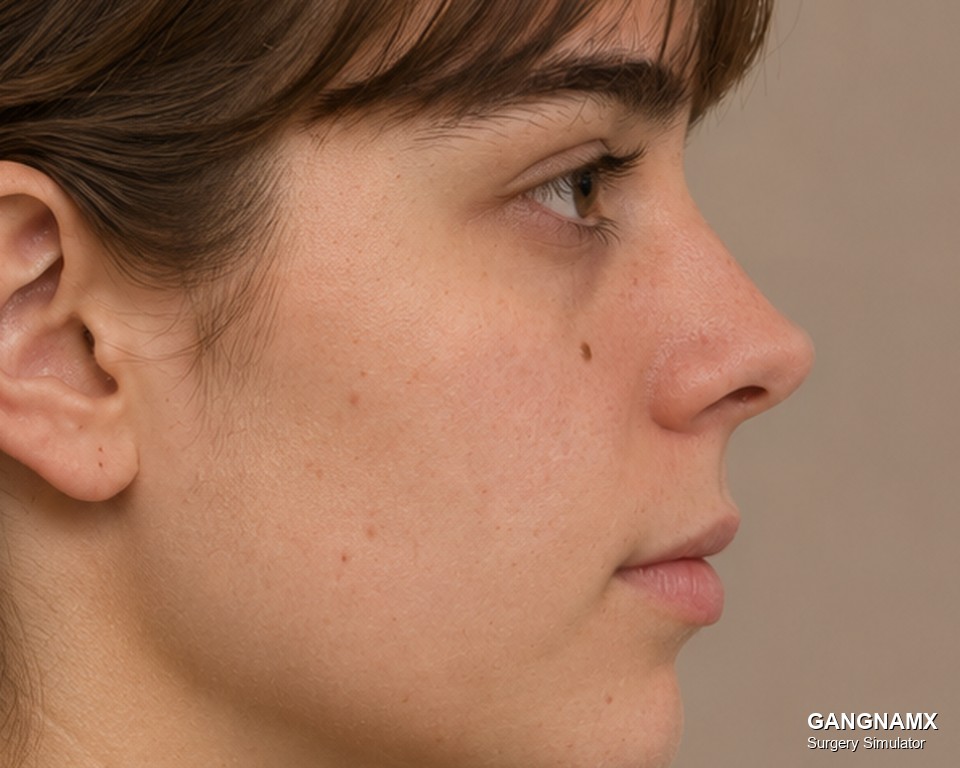
Notice that this is a small change in absolute terms, a matter of millimetres at the tip. It is the scale of change a surgeon can discuss, and it is also close to the scale a bad light day can imitate. That is why you control the light first.
In a front photo, a tip change shows up as a narrower, softer tip, and the width across the nostrils stays the same.
Look at the pictures at arm’s length, then at a distance. Features that matter stay visible from far away. Features that vanish at a distance are usually the ones the light was making up.
Bring a tidy set to the room
When you prepare for a consultation, a coordinator will ask for reference photos and the questions you want answered. Four tidy photos in the same light make that conversation shorter.
Bring the date and time on each photo. If the nose looks different across them, say so. The surgeon can then judge whether the difference is the camera, the swelling or the structure. That assessment belongs to the clinician, not to the photo.
Write one sentence about what bothers you. “The tip looks heavy in side photos” is useful. “My nose looks bad” is not.
Before you decide
- Do: take front and 90 degree side photos in the same window light, on three different days.
- Do: compare a morning photo with an evening photo.
- Do: write down the one thing that bothers you, in plain words.
- Don’t: judge your nose from a close selfie or a bathroom mirror.
- Don’t: plan a change around a single puffy day.
- Ask: what is structure, what is soft tissue, and what is camera angle on my own face?
A preview does not replace a surgeon’s exam. It gives you a calm, consistent picture to react to, so you walk in with a clear brief instead of a mood.
Simulation images by GangnamX.
 Plastic Surgery SimulatorKnow before you go.Simulate my face